Analysis of New Tax Policy 2026 and Impact on FDI Enterprises in Vietnam
The year 2026 is expected to mark a historic turning point in tax administration in Vietnam. A series of important draft amended and supplemented tax laws are being submitted to the National Assembly and are expected to take effect, creating a completely new tax legal framework applicable from January 1, 2026.
The core changes of the new tax policy 2026 focus on three main pillars: (1) Comprehensive reform of the method of calculating business household (HKD) tax by completely eliminating the concept of “consolidated tax”; (2) Tightening regulations on input and output invoices to prevent tax fraud and make cash flow transparent; and (3) Adjusting the Personal Income Tax (PIT) schedule according to two new options, directly affecting the salary fund and human resource policy.
For international investors and FDI enterprises operating in Vietnam, these adjustments not only have indirect impacts through the supply chain and suppliers, but also directly affect operating costs, human resource policies and legal compliance risks.
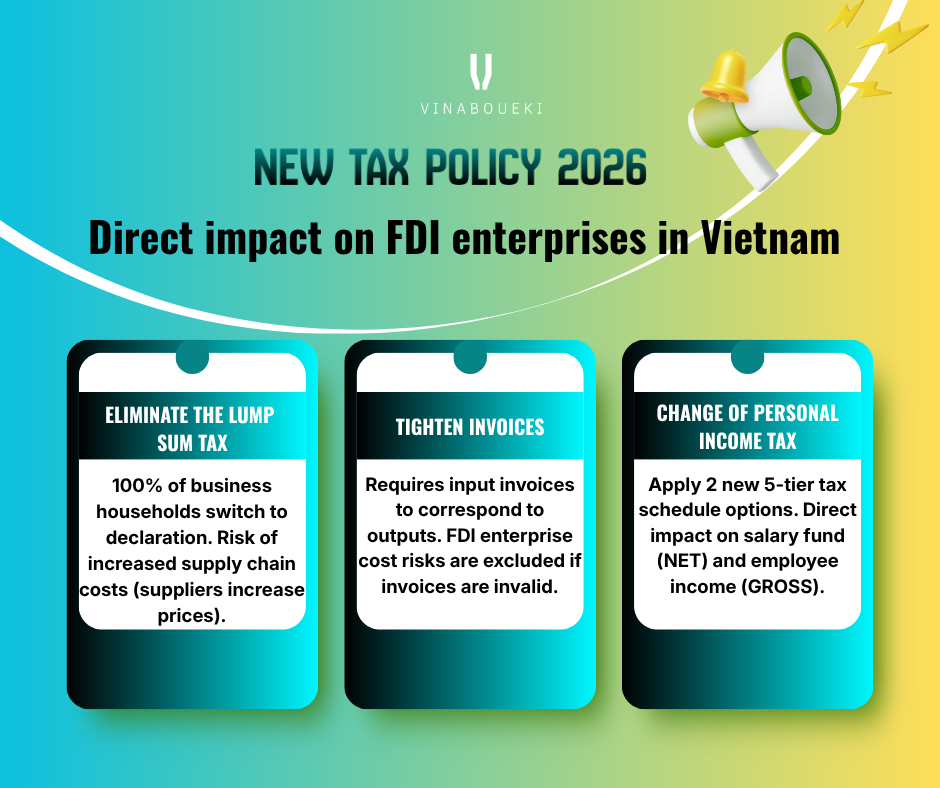
1. General Overview of the Historic Tax Reform in 2026
This tax reform demonstrates the Vietnamese Government’s strong determination to modernize the tax system, aligning with international standards (OECD). The main objectives are to enhance transparency, thoroughly implement electronic invoicing in all transactions, and, most importantly, combat state budget revenue loss, especially from the informal economic sector.
Stricter tax management is an inevitable trend, contributing to building a fair and healthy investment environment. This is also the spirit that Vina Boueki consistently pursues: contributing to building a transparent, efficient, and reliable Vietnam in the eyes of the world.
We understand that for nations to confidently invest in Vietnam, the legal foundation must be solid. Understanding and complying with these new regulations is not a burden, but an opportunity for FDI enterprises to assert their professionalism and achieve sustainable development.
2. Analysis of the Abolition of Presumptive Tax: Impact on the Supply Chain
The most revolutionary change in the new tax policy for 2026 is the complete abolition of the presumptive tax method (paying a fixed tax amount) for business households (HKDs). From 2026, 100% of HKDs will be required to switch to monthly or quarterly declaration-based taxation.
This puts an end to the era where many small suppliers operated under the presumptive tax scheme, which often led to a lack of transparency regarding actual revenue.
2.1. Three New Tax Calculation Groups for Business Households (From 2026)
According to the draft, business households (which account for up to 90% of small service providers and raw material suppliers) will be reclassified into three main tax calculation groups:
- Group 1: Tax Exempt (Revenue under 200 million VND/year)
HKDs with revenue under 200 million VND/year will only need to file declarations and will not be subject to Value Added Tax (VAT) and Personal Income Tax (PIT). This threshold is raised from the current 100 million VND/year.
- Group 2: Direct Declaration (Revenue from 200 million VND to 3 billion VND/year)
This group accounts for the vast majority of HKDs. This group will be subject to tax calculated as a direct percentage of total revenue, without deducting input costs.Illustrative example: An HKD providing food services with a revenue of 20 million VND/month (240 million VND/year). With an estimated service tax rate (e.g., 3-5%), this HKD will have to pay from 700,000 to 1 million VND/month, regardless of the cost of raw materials, labor, or rent.
- Group 3: Deduction-based Declaration (Revenue above 3 billion VND/year)
HKDs with large revenue scales will be managed almost like enterprises. They will pay VAT using the deduction method (Output – Input) and pay PIT at 17% on profits (Revenue – Eligible Expenses).
2.2. Dual Impact on FDI Enterprises
The application of tax based on total revenue (Group 2) will undoubtedly place significant financial pressure on business households. For FDI enterprises, this presents both risks and opportunities:
-
Cost Risk: Small suppliers (office supplies, industrial catering, cleaning, small transportation services…) currently partnering with FDI enterprises, if they fall into Group 2, will have to recalculate their selling prices. To ensure profitability after paying tax on total revenue, they will inevitably have to increase the selling price of services/products provided to enterprises. FDI enterprises need to budget for a sudden increase in input costs from 2026.
-
Transparency Opportunity: For large suppliers (Group 3), their transition to the deduction method will help the input VAT invoice system of FDI enterprises become more transparent and reliable, minimizing legal risks when working with larger entities.
-
Recommended Action: FDI enterprises need to immediately review their entire list of business household suppliers. Enterprises must proceed to renegotiate contract terms and unit prices, based on the new tax structure that suppliers will bear, to avoid being passive about operating costs.
3. Tightened Management of Input Invoices: New Legal Risks for Enterprises
The second area of tightened control in the new tax policy for 2026 is the regulation on invoice validity. Tax authorities will apply technology for cross-verification and require: Corresponding input invoices must be available to issue output invoices.
If an HKD or enterprise continuously issues output invoices (sales) without corresponding input invoices (purchases) aligned with its business sector, the tax system will automatically flag it and categorize it as “suspected of not having actual business operations.” Such cases are highly likely to be subject to tax inspection.
3.1. Challenges in Input Invoice Compliance
The biggest challenge for HKDs is collecting input invoices.
-
Legitimate Sources: HKDs must purchase goods from entities that issue invoices, such as supermarkets, companies, other businesses (buying rice, meat, vegetables, supplies, tools…).
-
Sources without Invoices (Market Purchases): This is a significant issue. When purchasing goods from farmers or small traders in traditional markets, HKDs will not receive electronic invoices. In such cases, the law allows HKDs to prepare a Declaration Form 01/TNDN accompanied by proof of payment (such as bank transfers) to legitimize input.
This tightening aims to prevent the situation of fictitious invoice trading, which has been a serious problem causing significant tax revenue loss. (For more on this risk, enterprises can refer to analyses from official news sources such as Dân Trí).
3.2. What FDI Enterprises Need to Do to Ensure Cost Validity
This is a direct legal risk that the Accounting and Purchasing departments of FDI enterprises must face.
-
Legal Warning: When an FDI enterprise receives an input invoice from a supplier (an HKD or another enterprise), if tax authorities later inspect and determine that the supplier “had no actual operations” (due to lack of input), all invoices they issued to the FDI enterprise will be considered invalid.
-
Financial Consequence: The costs corresponding to these invalid invoices will be excluded from eligible expenses when the FDI enterprise performs Corporate Income Tax (CIT) finalization. This means the enterprise will have to pay penalties and back taxes for the disallowed costs.
-
Solution from Vina Boueki: FDI enterprises cannot simply accept invoices. Vina Boueki recommends that enterprises immediately establish a “Supplier Compliance Check” process. Before signing large contracts, the purchasing department should require partners to provide legal capacity documents, and even request to review their Declaration Form 01/TNDN and payment proofs (if they purchase from markets) to ensure the actual nature of their business operations.
For more in-depth advice on how to build a legal risk control and compliance process for your supply chain, enterprises can refer to Vina Boueki’s Legal Consulting and Business Compliance Services.
4. Analysis of Two Options for Personal Income Tax (PIT) Adjustment Schedule 2026
In parallel with enterprise and HKD tax reforms, the draft Law on Personal Income Tax (amended) is also being presented with a significant change: reducing the progressive tax schedule from the current 7 brackets to 5 brackets.
Currently, two options are being proposed for feedback and are expected to apply from 2026, directly impacting the net income of employees and the payroll budget of enterprises.
4.1. Detailed Comparison of the Two New Tax Schedule Options
Both options maintain a 5% tax rate for income up to 10 million VND/month. The difference lies in the higher income brackets, which typically include middle and senior management personnel at FDI enterprises.
Below is a detailed comparison table of the two options (applied to taxable income, i.e., income after deducting personal allowances and tax-exempt amounts):
| Bracket | Taxable Income/month (Million VND) – Option 1 | Taxable Income/month (Million VND) – Option 2 | Tax Rate |
| 1 | Up to 10 | Up to 10 | 5% |
| 2 | Over 10 to 30 | Over 10 to 30 | 15% |
| 3 | Over 30 to 50 | Over 30 to 60 | 25% |
| 4 | Over 50 to 80 | Over 60 to 100 | 30% |
| 5 | Over 80 | Over 100 | 35% |
4.2. Impact on HR Policy and Payroll
This adjustment may seem “lighter” for some groups but increases the tax burden on others, depending on which option is chosen. The Human Resources and Accounting (HR/Admin) departments of FDI enterprises need to pay special attention.
-
For Enterprises with NET Salary Commitments: Any change that increases the tax rate at a specific income bracket (e.g., Option 1 applies 30% tax for the 50-80 million bracket, while Option 2 is more lenient) will mean the enterprise bears the additional PIT cost. This directly increases payroll costs.
-
For Enterprises Paying GROSS Salary: Employees will be the ones who feel the change most directly. If the tax payable increases (due to falling into a higher tax bracket), their net take-home pay will decrease. This inevitably leads to pressure to negotiate a higher GROSS salary to offset the increased tax.
-
Solution from Vina Boueki: The new tax policy for 2026 is a golden opportunity for FDI enterprises to review and restructure their entire compensation and benefits (C&B) system. Simply adjusting numbers is not enough. Enterprises need a strategy to build a new salary scale, legally optimize tax-exempt allowances and benefits, and clearly communicate this roadmap to employees.
This is an area where Vina Boueki has particular strengths, with experience working with Japanese and Korean enterprises that have the most stringent standards for payroll management and tax compliance. Enterprises can explore comprehensive solutions at Vina Boueki’s Payroll and Salary Scale Construction Services.
5. 2026 Tax Management Outlook – Recommendations from Vina Boueki
The year 2026 is expected to be a “challenging” year for tax compliance. Tax authorities will tighten management across all fronts, from the smallest business households to large FDI enterprises. Transparent declaration, valid input and output invoices, and strict cash flow monitoring are mandatory requirements.
With 20 years of experience accompanying investors, Vina Boueki recommends that enterprises take immediate action with the following 4 strategic steps:
-
Comprehensive Supplier Review: Immediately classify business household suppliers, assess the risk of price increases (if they fall into Group 2), and legal invoice risks (if they cannot prove their input).
-
Contract Updates: Revise purchase contract terms, adding clauses that bind suppliers’ responsibility for invoice validity and their obligation to provide explanations during tax inspections.
-
Payroll Budget Scenario Planning: HR and Finance departments need to run simulations for both new PIT options to calculate the impact on the payroll budget and prepare for salary scale adjustments.
-
Technology System Preparation: Ensure the enterprise’s accounting and HR software systems are ready to automatically and accurately update new tax schedules and declaration processes.
The changes in the new tax policy for 2026 are an inevitable step to bring Vietnam’s tax system closer to international standards and to enhance the transparency of the investment environment. This transition process will certainly create many short-term operational challenges but will bring long-term sustainable benefits to systematically operating businesses.
With 20 years of legal expertise, deep understanding of working practices in Vietnam, and high-quality Japanese standard processes, Vina Boueki does not only provide tax finalization services. We are a trusted partner, helping enterprises anticipate risks, build a sustainable legal compliance system, and optimize operational costs.
Do not wait until the law officially takes effect and causes operational disruptions. Enterprises should contact Vina Boueki today to receive strategic advice for their financial, HR,