Author Archives: vinaboueki

PIT Finalization for Expatriates in Vietnam

Personal income tax settlement for foreigners-Vinaboueki

In 2025, PIT finalization for expatriates demands absolute precision in determining residency status and declaring global income. To ensure legal compliance and avoid administrative penalties, businesses must master the deadlines, dependent documentation requirements, and the latest regulations on electronic transactions.

1. Expatriates Subject to PIT Finalization

Correctly identifying the subject is the prerequisite step to applying the appropriate tax rate. Under current regulations, foreigners working in Vietnam are divided into two main groups based on their duration of stay and residence.

Resident Individuals

An individual is identified as a resident of Vietnam if they satisfy one of the following conditions:

  • Being present in Vietnam for 183 days or more within a calendar year or within 12 consecutive months from the first day of arrival in Vietnam.

  • Having a regular residence in Vietnam according to the law on residence or having a leased house for stay in Vietnam with lease contracts of 183 days or more within the tax year.

For resident individuals, taxable income is income arising within and outside the territory of Vietnam, regardless of where the income is paid.

Non-resident Individuals

Individuals who do not meet the above conditions are considered non-residents. This group is only liable for PIT on the portion of income arising in Vietnam at a flat tax rate of 20%, with no family relief deductions allowed.

Authorized Finalization Cases

A business may perform the finalization on behalf of an employee if that individual only has income from wages or salaries, has signed a labor contract of 3 months or more with the business, and is actually working there at the time of finalization.


2. Standard PIT Finalization Process for Foreign Experts

To ensure accuracy and optimize time, businesses should apply a streamlined yet comprehensive control process as follows:

  1. Review and Collect Documents: Gather all tax withholding certificates, Letters of Confirmation for income paid abroad, and invoices/documents related to insurance or charities.

  2. Determine Deductions: Check family relief records for the individual and their dependents. Note that dependent documents from abroad must be consularly legalized in accordance with regulations.

  3. Prepare and Submit Declarations: Use the latest HTKK software or declare online via the General Department of Taxation’s e-portal. Ensure that taxable income and withheld tax figures match the accounting books.

  4. Tax Payment or Refund: After submission, the business or individual pays any additional tax (if underpaid) or proceeds with tax refund/offset procedures for the next period (if overpaid).


3. Updates on the Latest 2025 Legal Regulations and Decrees

The year 2025 marks a turning point in the digitalization of tax management. Decree 126/2020/NĐ-CP and Law on Tax Administration No. 38 remain the primary legal frameworks, but new guiding circulars have emphasized the following:

  • Personal Digital Signatures: Individuals performing self-finalization are encouraged and gradually required to have a digital signature or register an e-tax transaction account to approve documents online.

  • Submission Deadlines: For individuals performing self-finalization, the deadline is the last day of the 4th month from the end of the calendar year. For businesses finalizing on behalf of employees, the deadline is the last day of the 3rd month.

  • Global Income Processing: Tax authorities are increasing the review of international tax information exchange data to monitor income earned outside of Vietnam by foreign experts.


4. Calculating PIT for Expatriates with Global Income

This is the most complex aspect of tax finalization. For resident individuals, income from all sources worldwide must be converted into Vietnam Dong (VND) using the average interbank foreign exchange market rate at the time the income arises.

Applying Double Taxation Agreements (DTA)

Vietnam has signed DTAs with over 80 countries and territories. If a foreigner has paid income tax in their home country (e.g., Japan), they may deduct the tax paid abroad from the tax payable in Vietnam, provided it does not exceed the tax payable calculated under Vietnam’s tax tariff.

Utilizing DTAs effectively not only ensures compliance with international law but also helps businesses significantly optimize senior personnel costs.

Monthly Taxable Income (Million VND) Tax Rate
Up to 5 5%
Above 5 to 10 10%
Above 10 to 18 15%
Above 18 to 32 20%
Above 32 to 52 25%
Above 52 to 80 30%
Above 80 35%

5. Required Documents for Expatriate PIT Finalization

A well-prepared dossier will help businesses shorten the processing time with tax authorities. Essential documents include:

  • Tax finalization return Form No. 02/QTT-TNCN (for individuals) or 05/QTT-TNCN (for organizations).

  • Appendix listing details of dependents for family relief.

  • Certified copy of passport to verify the number of days stayed in Vietnam.

  • Tax withholding certificates and global income confirmation from the parent company or paying entity abroad.

  • Dependent supporting documents (if any): Birth certificates, marriage certificates—consularly legalized and notarized with translation.


6. PIT Refund for Foreigners upon Completion of Assignment in Vietnam

When foreign experts finish their term and leave Vietnam, they must perform tax finalization up to the date of departure. This is a crucial step to close the tax identification number (TIN) and complete obligations to the Vietnamese state.

In many cases, the monthly withheld tax is higher than the actual tax payable based on the actual working time. In such instances, the individual is entitled to a tax refund. Vina Boueki recommends that businesses support experts in completing this procedure before they leave the territory to ensure their rights and avoid future legal complications should they wish to return to work.

Personal income tax settlement for foreigners-Vinaboueki


7. Common Mistakes and Legal Risks for Businesses

Below are the errors Vina Boueki frequently records during consulting:

  • Incorrect Determination of Residency Status: Calculating a flat 20% tax for the entire year when the individual was actually in Vietnam for over 183 days.

  • Omission of Income: Failing to declare cash allowances or non-monetary benefits (such as tuition for children or home leave airfare) which are taxable.

  • Invalid Deduction Documents: Using overseas documents without the mandatory consular legalization stamp from the Vietnamese consulate.

  • Late Submission: Leading to high administrative tax penalties as stipulated in Decree 125/2020/NĐ-CP.


8. Professional PIT Finalization Services at Vina Boueki

With 20 years of experience accompanying FDI enterprises, particularly companies from Japan and South Korea, Vina Boueki is proud to provide comprehensive business support and tax finalization solutions. We understand that every figure on a declaration represents not just a financial obligation but the reputation of the business.

At Vina Boueki, our quality control process is built on Japanese standards: accurate, transparent, and confidential. Our team of experts does more than just calculate; we act as advisors, helping businesses review their entire salary, insurance, and HR policy systems to ensure maximum optimization.

During any tax audit or inspection, Vina Boueki is always ready to represent or accompany the business to explain and protect the unit’s legitimate interests based on a deep understanding of local laws.


9. Frequently Asked Questions about PIT

Can an expat with two sources of income authorize a business to finalize their tax?

No. According to regulations, individuals with income from two or more sources must perform the finalization directly with the tax authorities.

How long does a PIT refund usually take?

By law, the processing time for a tax refund dossier is between 6 to 40 working days from the receipt of a complete and valid dossier, depending on whether it falls under the “Refund first, Audit later” or “Audit first, Refund later” category.

Does Vina Boueki support finalization for foreigners who have already returned home?

Yes. Vina Boueki provides authorization services to perform tax procedures for experts who have departed, ensuring all obligations are fully completed.

Conclusion

Performing PIT finalization for expatriates in 2025 requires meticulousness, legal expertise, and timely updates. A well-organized system will give businesses peace of mind to grow sustainably in the Vietnamese market. If your business is facing difficulties with documentation or wishes to optimize tax management processes, please contact the experts at Vina Boueki for the most dedicated and professional support.

Analysis of New Tax Policy 2026 and Impact on FDI Enterprises in Vietnam

VBE-tax 2026-vietnam

Analysis of New Tax Policy 2026 and Impact on FDI Enterprises in Vietnam

The year 2026 is expected to mark a historic turning point in tax administration in Vietnam. A series of important draft amended and supplemented tax laws are being submitted to the National Assembly and are expected to take effect, creating a completely new tax legal framework applicable from January 1, 2026.

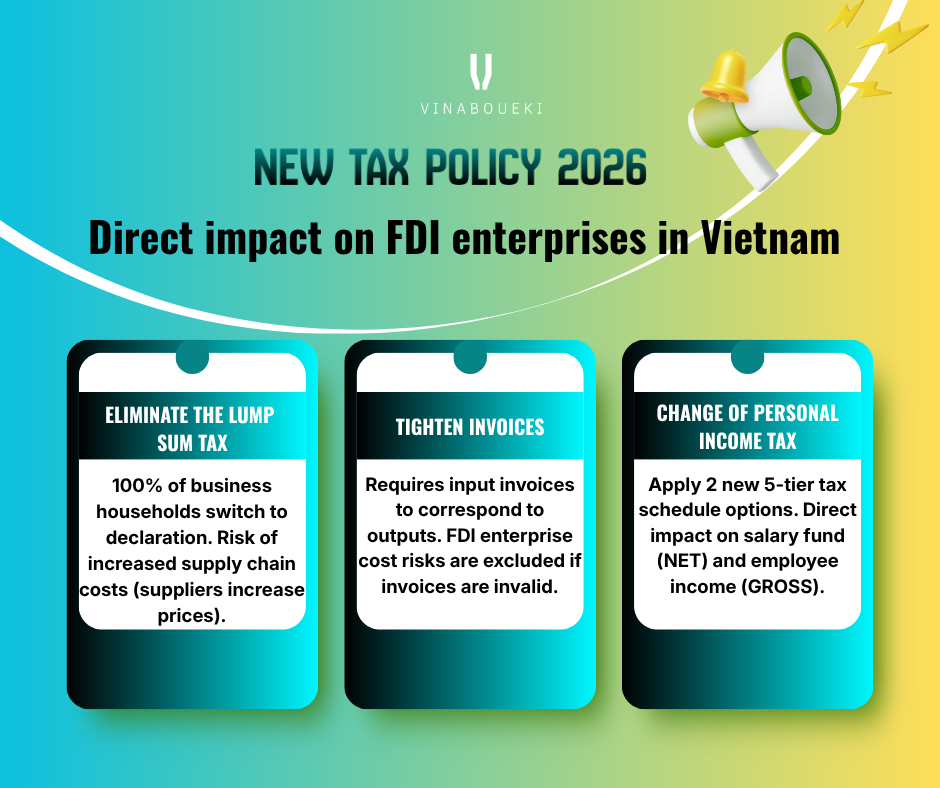
The core changes of the new tax policy 2026 focus on three main pillars: (1) Comprehensive reform of the method of calculating business household (HKD) tax by completely eliminating the concept of “consolidated tax”; (2) Tightening regulations on input and output invoices to prevent tax fraud and make cash flow transparent; and (3) Adjusting the Personal Income Tax (PIT) schedule according to two new options, directly affecting the salary fund and human resource policy.

For international investors and FDI enterprises operating in Vietnam, these adjustments not only have indirect impacts through the supply chain and suppliers, but also directly affect operating costs, human resource policies and legal compliance risks.

VBE-tax 2026-vietnam

1. General Overview of the Historic Tax Reform in 2026

This tax reform demonstrates the Vietnamese Government’s strong determination to modernize the tax system, aligning with international standards (OECD). The main objectives are to enhance transparency, thoroughly implement electronic invoicing in all transactions, and, most importantly, combat state budget revenue loss, especially from the informal economic sector.

Stricter tax management is an inevitable trend, contributing to building a fair and healthy investment environment. This is also the spirit that Vina Boueki consistently pursues: contributing to building a transparent, efficient, and reliable Vietnam in the eyes of the world.

We understand that for nations to confidently invest in Vietnam, the legal foundation must be solid. Understanding and complying with these new regulations is not a burden, but an opportunity for FDI enterprises to assert their professionalism and achieve sustainable development.

2. Analysis of the Abolition of Presumptive Tax: Impact on the Supply Chain

The most revolutionary change in the new tax policy for 2026 is the complete abolition of the presumptive tax method (paying a fixed tax amount) for business households (HKDs). From 2026, 100% of HKDs will be required to switch to monthly or quarterly declaration-based taxation.

This puts an end to the era where many small suppliers operated under the presumptive tax scheme, which often led to a lack of transparency regarding actual revenue.

2.1. Three New Tax Calculation Groups for Business Households (From 2026)

According to the draft, business households (which account for up to 90% of small service providers and raw material suppliers) will be reclassified into three main tax calculation groups:

  • Group 1: Tax Exempt (Revenue under 200 million VND/year)

    HKDs with revenue under 200 million VND/year will only need to file declarations and will not be subject to Value Added Tax (VAT) and Personal Income Tax (PIT). This threshold is raised from the current 100 million VND/year.

  • Group 2: Direct Declaration (Revenue from 200 million VND to 3 billion VND/year)

    This group accounts for the vast majority of HKDs. This group will be subject to tax calculated as a direct percentage of total revenue, without deducting input costs.Illustrative example: An HKD providing food services with a revenue of 20 million VND/month (240 million VND/year). With an estimated service tax rate (e.g., 3-5%), this HKD will have to pay from 700,000 to 1 million VND/month, regardless of the cost of raw materials, labor, or rent.

  • Group 3: Deduction-based Declaration (Revenue above 3 billion VND/year)

    HKDs with large revenue scales will be managed almost like enterprises. They will pay VAT using the deduction method (Output – Input) and pay PIT at 17% on profits (Revenue – Eligible Expenses).

2.2. Dual Impact on FDI Enterprises

The application of tax based on total revenue (Group 2) will undoubtedly place significant financial pressure on business households. For FDI enterprises, this presents both risks and opportunities:

  • Cost Risk: Small suppliers (office supplies, industrial catering, cleaning, small transportation services…) currently partnering with FDI enterprises, if they fall into Group 2, will have to recalculate their selling prices. To ensure profitability after paying tax on total revenue, they will inevitably have to increase the selling price of services/products provided to enterprises. FDI enterprises need to budget for a sudden increase in input costs from 2026.

  • Transparency Opportunity: For large suppliers (Group 3), their transition to the deduction method will help the input VAT invoice system of FDI enterprises become more transparent and reliable, minimizing legal risks when working with larger entities.

  • Recommended Action: FDI enterprises need to immediately review their entire list of business household suppliers. Enterprises must proceed to renegotiate contract terms and unit prices, based on the new tax structure that suppliers will bear, to avoid being passive about operating costs.

3. Tightened Management of Input Invoices: New Legal Risks for Enterprises

The second area of tightened control in the new tax policy for 2026 is the regulation on invoice validity. Tax authorities will apply technology for cross-verification and require: Corresponding input invoices must be available to issue output invoices.

If an HKD or enterprise continuously issues output invoices (sales) without corresponding input invoices (purchases) aligned with its business sector, the tax system will automatically flag it and categorize it as “suspected of not having actual business operations.” Such cases are highly likely to be subject to tax inspection.

3.1. Challenges in Input Invoice Compliance

The biggest challenge for HKDs is collecting input invoices.

  • Legitimate Sources: HKDs must purchase goods from entities that issue invoices, such as supermarkets, companies, other businesses (buying rice, meat, vegetables, supplies, tools…).

  • Sources without Invoices (Market Purchases): This is a significant issue. When purchasing goods from farmers or small traders in traditional markets, HKDs will not receive electronic invoices. In such cases, the law allows HKDs to prepare a Declaration Form 01/TNDN accompanied by proof of payment (such as bank transfers) to legitimize input.

This tightening aims to prevent the situation of fictitious invoice trading, which has been a serious problem causing significant tax revenue loss. (For more on this risk, enterprises can refer to analyses from official news sources such as Dân Trí).

3.2. What FDI Enterprises Need to Do to Ensure Cost Validity

This is a direct legal risk that the Accounting and Purchasing departments of FDI enterprises must face.

  • Legal Warning: When an FDI enterprise receives an input invoice from a supplier (an HKD or another enterprise), if tax authorities later inspect and determine that the supplier “had no actual operations” (due to lack of input), all invoices they issued to the FDI enterprise will be considered invalid.

  • Financial Consequence: The costs corresponding to these invalid invoices will be excluded from eligible expenses when the FDI enterprise performs Corporate Income Tax (CIT) finalization. This means the enterprise will have to pay penalties and back taxes for the disallowed costs.

  • Solution from Vina Boueki: FDI enterprises cannot simply accept invoices. Vina Boueki recommends that enterprises immediately establish a “Supplier Compliance Check” process. Before signing large contracts, the purchasing department should require partners to provide legal capacity documents, and even request to review their Declaration Form 01/TNDN and payment proofs (if they purchase from markets) to ensure the actual nature of their business operations.

For more in-depth advice on how to build a legal risk control and compliance process for your supply chain, enterprises can refer to Vina Boueki’s Legal Consulting and Business Compliance Services.

4. Analysis of Two Options for Personal Income Tax (PIT) Adjustment Schedule 2026

In parallel with enterprise and HKD tax reforms, the draft Law on Personal Income Tax (amended) is also being presented with a significant change: reducing the progressive tax schedule from the current 7 brackets to 5 brackets.

Currently, two options are being proposed for feedback and are expected to apply from 2026, directly impacting the net income of employees and the payroll budget of enterprises.

4.1. Detailed Comparison of the Two New Tax Schedule Options

Both options maintain a 5% tax rate for income up to 10 million VND/month. The difference lies in the higher income brackets, which typically include middle and senior management personnel at FDI enterprises.

Below is a detailed comparison table of the two options (applied to taxable income, i.e., income after deducting personal allowances and tax-exempt amounts):

Bracket Taxable Income/month (Million VND) – Option 1 Taxable Income/month (Million VND) – Option 2 Tax Rate
1 Up to 10 Up to 10 5%
2 Over 10 to 30 Over 10 to 30 15%
3 Over 30 to 50 Over 30 to 60 25%
4 Over 50 to 80 Over 60 to 100 30%
5 Over 80 Over 100 35%

4.2. Impact on HR Policy and Payroll

This adjustment may seem “lighter” for some groups but increases the tax burden on others, depending on which option is chosen. The Human Resources and Accounting (HR/Admin) departments of FDI enterprises need to pay special attention.

  • For Enterprises with NET Salary Commitments: Any change that increases the tax rate at a specific income bracket (e.g., Option 1 applies 30% tax for the 50-80 million bracket, while Option 2 is more lenient) will mean the enterprise bears the additional PIT cost. This directly increases payroll costs.

  • For Enterprises Paying GROSS Salary: Employees will be the ones who feel the change most directly. If the tax payable increases (due to falling into a higher tax bracket), their net take-home pay will decrease. This inevitably leads to pressure to negotiate a higher GROSS salary to offset the increased tax.

  • Solution from Vina Boueki: The new tax policy for 2026 is a golden opportunity for FDI enterprises to review and restructure their entire compensation and benefits (C&B) system. Simply adjusting numbers is not enough. Enterprises need a strategy to build a new salary scale, legally optimize tax-exempt allowances and benefits, and clearly communicate this roadmap to employees.

This is an area where Vina Boueki has particular strengths, with experience working with Japanese and Korean enterprises that have the most stringent standards for payroll management and tax compliance. Enterprises can explore comprehensive solutions at Vina Boueki’s Payroll and Salary Scale Construction Services.

5. 2026 Tax Management Outlook – Recommendations from Vina Boueki

The year 2026 is expected to be a “challenging” year for tax compliance. Tax authorities will tighten management across all fronts, from the smallest business households to large FDI enterprises. Transparent declaration, valid input and output invoices, and strict cash flow monitoring are mandatory requirements.

With 20 years of experience accompanying investors, Vina Boueki recommends that enterprises take immediate action with the following 4 strategic steps:

  1. Comprehensive Supplier Review: Immediately classify business household suppliers, assess the risk of price increases (if they fall into Group 2), and legal invoice risks (if they cannot prove their input).

  2. Contract Updates: Revise purchase contract terms, adding clauses that bind suppliers’ responsibility for invoice validity and their obligation to provide explanations during tax inspections.

  3. Payroll Budget Scenario Planning: HR and Finance departments need to run simulations for both new PIT options to calculate the impact on the payroll budget and prepare for salary scale adjustments.

  4. Technology System Preparation: Ensure the enterprise’s accounting and HR software systems are ready to automatically and accurately update new tax schedules and declaration processes.

The changes in the new tax policy for 2026 are an inevitable step to bring Vietnam’s tax system closer to international standards and to enhance the transparency of the investment environment. This transition process will certainly create many short-term operational challenges but will bring long-term sustainable benefits to systematically operating businesses.

With 20 years of legal expertise, deep understanding of working practices in Vietnam, and high-quality Japanese standard processes, Vina Boueki does not only provide tax finalization services. We are a trusted partner, helping enterprises anticipate risks, build a sustainable legal compliance system, and optimize operational costs.

Do not wait until the law officially takes effect and causes operational disruptions. Enterprises should contact Vina Boueki today to receive strategic advice for their financial, HR,

Top 5 Reputable Work Permit Services for International Companies in Vietnam

ina Boueki expert consulting on work permit services for an international company.

Top 5 Reputable Work Permit Services for International Companies in Vietnam 2025

As the flow of foreign direct investment (FDI) into Vietnam grows stronger, so does the need for experts and senior personnel from around the world to directly manage and operate businesses. However, the process of obtaining a Work Permit (WP) for foreigners in Vietnam is complex, requiring a deep understanding of a legal landscape that is subject to frequent changes—especially with new regulations set to take effect from July 1, 2025. A minor oversight in this process can lead to delays in personnel planning, directly impacting business operations.

Choosing a consulting partner is not just about handling administrative procedures; it is a strategic decision to ensure smooth operations and legal compliance. This article will analyze the most critical criteria for selecting a service provider and introduce a list of the top 5 reputable firms trusted by international businesses for work permit consulting in Vietnam.

Why Choosing the Right WP Service Partner is a Strategic Decision

For international companies, which demand high standards of precision, transparency, and efficiency, selecting a work permit service partner is more than just outsourcing an administrative task. It is about finding an extension of their HR and legal departments—a partner who understands both the multinational corporate culture and Vietnam’s unique legal environment.

A poor choice can lead to unnecessary risks:

  • Legal Risks: Applications being repeatedly rejected, experts unable to start work on schedule, and even potential administrative penalties for employing unlicensed labor.
  • Increased Costs and Time: Protracted processes generate hidden costs, wasting the resources of the HR department and management.
  • Impact on Business Operations: Plans for project implementation, technology transfer, or factory operations can be stalled because key personnel are not yet cleared to work.

Therefore, an ideal partner is one who not only executes procedures but also provides strategic advice, foresees risks, and offers the most optimal solution for each company’s specific circumstances.

ina Boueki expert consulting on work permit services for an international company.

A List of the Top 5 Work Permit Consulting Firms for International Businesses

Here is a list of five providers highly regarded for their capabilities, experience, and understanding of the diverse needs of international companies in Vietnam.

1. Vina Boueki: A Comprehensive Partnership with International Standards

Topping the list is Vina Boueki, a firm that positions itself not just as a service provider but as a strategic partner throughout a company’s entire operational journey in Vietnam. With over 20 years of experience from its founding team in the legal and investment sectors, Vina Boueki offers a distinct solution that combines international quality standards with deep practical understanding of Vietnam.

  • Key Strengths:
    • Integrated Service Ecosystem: Vina Boueki understands that a Work Permit is just one link in the operational chain. Therefore, it provides a complete solution package covering Company Establishment, sub-licenses, Visas, Temporary Residence Cards (TRCs), to Payroll Services, Tax, and Social Insurance (SI). This allows international businesses to work with a single point of contact, ensuring consistency and minimizing the administrative burden.
    • International Quality Standards & Vietnamese Know-How: Every process at Vina Boueki is built on rigorous international standards: precision, transparency, timely reporting, and meticulous attention to detail. Notably, our extensive experience serving numerous Japanese enterprises—globally recognized for their strict and demanding quality standards—has honed our service process to a level of outstanding precision and dedication. This proves our capability to meet and exceed the expectations of any international investor.
    • Capacity to Handle Complex Cases: With extensive hands-on experience, Vina Boueki has successfully managed numerous difficult cases for clients from many different countries, such as experts lacking specific required qualifications, unique job positions not listed in standard categories, or applications requiring urgent processing.
    • Multilingual Expert Team: Vina Boueki’s specialists can discuss and provide in-depth consultation directly in English, Japanese, and Vietnamese, breaking down language barriers and ensuring complex legal information is conveyed with the utmost accuracy.
  • Best suited for: International companies of all sizes (from SMEs to large corporations) seeking a long-term strategic partner who not only solves immediate problems but also advises on a path of sustainable, compliant growth in Vietnam.

2. KPMG Legal

KPMG is one of the “Big Four” major names in the audit and advisory industry. Its legal arm in Vietnam offers a wide range of legal consulting services, including support for foreign employees.

  • Key Strengths:
    • Global Brand: Its global reputation and network are a significant advantage, providing assurance to large multinational corporations.
    • Large Team of Lawyers: Capable of handling large-scale, complex legal matters.
  • Points to Consider: Service fees are typically in the high range, and processes can be quite rigid, sometimes lacking the flexibility needed by SMEs or for requests that require a quick turnaround.

3. Acclime Vietnam

Acclime is a leading corporate service provider with an extensive network across Asia. In Vietnam, Acclime supports foreign investors in numerous areas, from company incorporation and accounting to tax and HR.

  • Key Strengths:
    • Regional Network: Experience and presence in multiple Asian markets can be beneficial for companies with a regional expansion strategy.
    • Comprehensive Corporate Services: Offers a wide range of essential services for compliance and operations.
  • Points to Consider: As a large, process-driven firm, the service may lack the deep personalization and flexibility of a boutique firm, especially when handling complex, non-standard labor cases.

4. Mazars Vietnam

Mazars is an international, integrated partnership specializing in audit, accountancy, advisory, tax, and legal services. With a strong presence in Vietnam, Mazars serves a wide range of foreign-invested enterprises.

  • Key Strengths:
    • International Network: As a global brand, Mazars offers reliability through its international standards and processes.
    • Deep Expertise in Tax & Finance: This is Mazars’ core strength, making it a great fit for companies that prioritize financial and tax compliance.
  • Points to Consider: Similar to other large advisory firms, the service can be less flexible and personalized. Work permit advisory is often bundled with larger financial packages and may not be the optimal choice for businesses with standalone needs.

5. Phuoc & Partners

Phuoc & Partners is a reputable Vietnamese law firm with extensive experience in corporate, labor, and tax law advisory for both local and international clients.

  • Key Strengths:
    • Solid Legal Expertise: The team of lawyers has a deep understanding of the Vietnamese legal system.
    • Diverse Consulting Experience: Has worked with a wide variety of businesses, providing a practical perspective.
  • Points to Consider: While professional, its primary focus on a purely legal perspective may not fully encompass the broader operational HR and payroll aspects that international businesses require.

At-a-Glance Comparison for an Easy Choice

For a clear overview, the table below compares the providers based on the criteria most important to an international enterprise.

Criteria Vina Boueki KPMG Legal Acclime Vietnam Mazars Vietnam Phuoc & Partners
Integrated Ecosystem Comprehensive (Legal – HR – Payroll – Tax) Broad but siloed departments Strong in compliance & corporate services Strong in Audit – Tax – Finance Specialized in Legal
Experience with Int’l Clients Very High Very High High High High
Flexibility for SMEs Very High Low Medium Medium Medium
International Standard Process Yes Yes Yes Yes Not a core strength
Cost Reasonable & Transparent Very High High High Competitive
Best For Businesses needing a strategic, all-in-one partner Large corporations requiring absolute compliance Businesses needing standardized regional compliance Businesses needing international audit & financial services Businesses needing specialized legal counsel

Conclusion: Choosing a Partner, Not Just a Provider

Successfully obtaining a work permit for a foreign expert is more than just completing a set of documents. It is a critical first step in ensuring that high-quality human resources can contribute to your company’s success in Vietnam legally and sustainably. Choosing the right service provider is an investment in peace of mind, efficiency, and compliance.

Instead of facing complex procedures and potential risks on your own, let a partner who truly understands your needs walk alongside you. A partner who not only executes but advises; who not only follows instructions but acts in the long-term interest of your business.

Are you facing challenges with HR procedures for foreign experts or in need of a reliable partner for compliant operations in Vietnam? Connect with Vina Boueki’s expert team today for a complimentary strategic consultation. We are committed to delivering solutions, not just services.

To learn more about the latest regulations, companies can refer to the official portal of the Ministry of Labour, Invalids and Social Affairs (MOLISA).

Top 5 Reputable Work Permit Services for International Companies in Vietnam

ina Boueki expert consulting on work permit services for an international company.

Top 5 Reputable Work Permit Services for International Companies in Vietnam 2025

As the flow of foreign direct investment (FDI) into Vietnam grows stronger, so does the need for experts and senior personnel from around the world to directly manage and operate businesses. However, the process of obtaining a Work Permit (WP) for foreigners in Vietnam is complex, requiring a deep understanding of a legal landscape that is subject to frequent changes—especially with new regulations set to take effect from July 1, 2025. A minor oversight in this process can lead to delays in personnel planning, directly impacting business operations.

Choosing a consulting partner is not just about handling administrative procedures; it is a strategic decision to ensure smooth operations and legal compliance. This article will analyze the most critical criteria for selecting a service provider and introduce a list of the top 5 reputable firms trusted by international businesses for work permit consulting in Vietnam.

Why Choosing the Right WP Service Partner is a Strategic Decision

For international companies, which demand high standards of precision, transparency, and efficiency, selecting a work permit service partner is more than just outsourcing an administrative task. It is about finding an extension of their HR and legal departments—a partner who understands both the multinational corporate culture and Vietnam’s unique legal environment.

A poor choice can lead to unnecessary risks:

  • Legal Risks: Applications being repeatedly rejected, experts unable to start work on schedule, and even potential administrative penalties for employing unlicensed labor.
  • Increased Costs and Time: Protracted processes generate hidden costs, wasting the resources of the HR department and management.
  • Impact on Business Operations: Plans for project implementation, technology transfer, or factory operations can be stalled because key personnel are not yet cleared to work.

Therefore, an ideal partner is one who not only executes procedures but also provides strategic advice, foresees risks, and offers the most optimal solution for each company’s specific circumstances.

ina Boueki expert consulting on work permit services for an international company.

A List of the Top 5 Work Permit Consulting Firms for International Businesses

Here is a list of five providers highly regarded for their capabilities, experience, and understanding of the diverse needs of international companies in Vietnam.

1. Vina Boueki: A Comprehensive Partnership with International Standards

Topping the list is Vina Boueki, a firm that positions itself not just as a service provider but as a strategic partner throughout a company’s entire operational journey in Vietnam. With over 20 years of experience from its founding team in the legal and investment sectors, Vina Boueki offers a distinct solution that combines international quality standards with deep practical understanding of Vietnam.

  • Key Strengths:
    • Integrated Service Ecosystem: Vina Boueki understands that a Work Permit is just one link in the operational chain. Therefore, it provides a complete solution package covering Company Establishment, sub-licenses, Visas, Temporary Residence Cards (TRCs), to Payroll Services, Tax, and Social Insurance (SI). This allows international businesses to work with a single point of contact, ensuring consistency and minimizing the administrative burden.
    • International Quality Standards & Vietnamese Know-How: Every process at Vina Boueki is built on rigorous international standards: precision, transparency, timely reporting, and meticulous attention to detail. Notably, our extensive experience serving numerous Japanese enterprises—globally recognized for their strict and demanding quality standards—has honed our service process to a level of outstanding precision and dedication. This proves our capability to meet and exceed the expectations of any international investor.
    • Capacity to Handle Complex Cases: With extensive hands-on experience, Vina Boueki has successfully managed numerous difficult cases for clients from many different countries, such as experts lacking specific required qualifications, unique job positions not listed in standard categories, or applications requiring urgent processing.
    • Multilingual Expert Team: Vina Boueki’s specialists can discuss and provide in-depth consultation directly in English, Japanese, and Vietnamese, breaking down language barriers and ensuring complex legal information is conveyed with the utmost accuracy.
  • Best suited for: International companies of all sizes (from SMEs to large corporations) seeking a long-term strategic partner who not only solves immediate problems but also advises on a path of sustainable, compliant growth in Vietnam.

2. KPMG Legal

KPMG is one of the “Big Four” major names in the audit and advisory industry. Its legal arm in Vietnam offers a wide range of legal consulting services, including support for foreign employees.

  • Key Strengths:
    • Global Brand: Its global reputation and network are a significant advantage, providing assurance to large multinational corporations.
    • Large Team of Lawyers: Capable of handling large-scale, complex legal matters.
  • Points to Consider: Service fees are typically in the high range, and processes can be quite rigid, sometimes lacking the flexibility needed by SMEs or for requests that require a quick turnaround.

3. Acclime Vietnam

Acclime is a leading corporate service provider with an extensive network across Asia. In Vietnam, Acclime supports foreign investors in numerous areas, from company incorporation and accounting to tax and HR.

  • Key Strengths:
    • Regional Network: Experience and presence in multiple Asian markets can be beneficial for companies with a regional expansion strategy.
    • Comprehensive Corporate Services: Offers a wide range of essential services for compliance and operations.
  • Points to Consider: As a large, process-driven firm, the service may lack the deep personalization and flexibility of a boutique firm, especially when handling complex, non-standard labor cases.

4. Mazars Vietnam

Mazars is an international, integrated partnership specializing in audit, accountancy, advisory, tax, and legal services. With a strong presence in Vietnam, Mazars serves a wide range of foreign-invested enterprises.

  • Key Strengths:
    • International Network: As a global brand, Mazars offers reliability through its international standards and processes.
    • Deep Expertise in Tax & Finance: This is Mazars’ core strength, making it a great fit for companies that prioritize financial and tax compliance.
  • Points to Consider: Similar to other large advisory firms, the service can be less flexible and personalized. Work permit advisory is often bundled with larger financial packages and may not be the optimal choice for businesses with standalone needs.

5. Phuoc & Partners

Phuoc & Partners is a reputable Vietnamese law firm with extensive experience in corporate, labor, and tax law advisory for both local and international clients.

  • Key Strengths:
    • Solid Legal Expertise: The team of lawyers has a deep understanding of the Vietnamese legal system.
    • Diverse Consulting Experience: Has worked with a wide variety of businesses, providing a practical perspective.
  • Points to Consider: While professional, its primary focus on a purely legal perspective may not fully encompass the broader operational HR and payroll aspects that international businesses require.

At-a-Glance Comparison for an Easy Choice

For a clear overview, the table below compares the providers based on the criteria most important to an international enterprise.

Criteria Vina Boueki KPMG Legal Acclime Vietnam Mazars Vietnam Phuoc & Partners
Integrated Ecosystem Comprehensive (Legal – HR – Payroll – Tax) Broad but siloed departments Strong in compliance & corporate services Strong in Audit – Tax – Finance Specialized in Legal
Experience with Int’l Clients Very High Very High High High High
Flexibility for SMEs Very High Low Medium Medium Medium
International Standard Process Yes Yes Yes Yes Not a core strength
Cost Reasonable & Transparent Very High High High Competitive
Best For Businesses needing a strategic, all-in-one partner Large corporations requiring absolute compliance Businesses needing standardized regional compliance Businesses needing international audit & financial services Businesses needing specialized legal counsel

Conclusion: Choosing a Partner, Not Just a Provider

Successfully obtaining a work permit for a foreign expert is more than just completing a set of documents. It is a critical first step in ensuring that high-quality human resources can contribute to your company’s success in Vietnam legally and sustainably. Choosing the right service provider is an investment in peace of mind, efficiency, and compliance.

Instead of facing complex procedures and potential risks on your own, let a partner who truly understands your needs walk alongside you. A partner who not only executes but advises; who not only follows instructions but acts in the long-term interest of your business.

Are you facing challenges with HR procedures for foreign experts or in need of a reliable partner for compliant operations in Vietnam? Connect with Vina Boueki’s expert team today for a complimentary strategic consultation. We are committed to delivering solutions, not just services.

To learn more about the latest regulations, companies can refer to the official portal of the Ministry of Labour, Invalids and Social Affairs (MOLISA).

Changes To Work Permit In Vietnam – Effective August 2025

New Regulations on Work Permits for Foreign Workers in Vietnam, Applicable from August 2025 - Vina Boueki

KEY CHANGES TO WORK PERMIT REGULATIONS FOR FOREIGNERS IN VIETNAM, EFFECTIVE AUGUST 2025

August 7, 2025, has become a landmark date for every enterprise employing foreign labor in Vietnam. With the issuance of Decree No. 219/2025/ND-CP (hereinafter referred to as “Decree 219”) by the Government, a comprehensive and unified official process has been established. Built on the foundation of the 2019 Labor Code, Decree 219 is not merely an amendment but a complete replacement and consolidation of all previously scattered regulations, creating an entirely new legal framework. From the definition of job positions and the authority of state agencies to every detail within the application dossiers and processing timelines, everything has been redefined with precision.

For managers, human resources professionals, and legal experts, thoroughly understanding and mastering these changes is not just a matter of compliance. It is a critical factor in building effective human resource strategies, avoiding legal risks, and ensuring that business operations continue without interruption.

New Regulations on Work Permits for Foreign Workers in Vietnam, Applicable from August 2025 - Vina Boueki

I. Summary of the Most Critical Changes for Businesses

For busy leaders, these are the core points to grasp immediately:

  1. A Single, Unified Document: Decree 219 completely replaces the regulations concerning foreign labor found in Decree 152/2020, Decree 70/2023, and even a portion of Decree 128/2024. Now, businesses need only to reference a single source.
  2. Authority Centralized at the Provincial Level: The Chairman of the Provincial People’s Committee is the final decision-maker for all procedures, from the new issuance and renewal to the revocation of work permits and exemption certificates.
  3. Quantified Standards for Job Positions: The roles of “Manager,” “Executive Director,” “Expert,” and “Technical Worker” have been redefined in great detail, with specific requirements for academic qualifications and years of experience.
  4. Clearly Defined Dossiers and Processing Times: The Decree specifies the list of documents for each procedure and sets clear processing timelines (e.g., 07 working days for a new work permit), creating a transparent legal basis for businesses to follow.
  5. Online Dossier Submission: Submitting applications is now officially permitted through the National Public Service Portal, paving the way for the digitalization of administrative procedures.

To ensure authenticity, businesses can consult the full text of Decree No. 219/2025/ND-CP on the Government’s official electronic portal.

II. A Before-and-After Comparison of Regulations

To clearly illustrate the regulatory shift, the following comparison table directly contrasts the old and new provisions on the most important aspects.

Criteria Old Regulations (Decree 152/2020 & 70/2023) New Regulations (Decree 219/2025/ND-CP) Impact Analysis
Applicable Documents Businesses had to reference multiple documents (Decree 152, Decree 70, and parts of Decree 128) to get a complete picture. A single, unified document. Decree 219 replaces all relevant previous regulations. Positive: Reduces complexity, contradictions, and legal risks from incorrect or incomplete references. Compliance and research become significantly easier.
Competent Authority The Department of Labor, Invalids and Social Affairs (DOLISA) or the Management Board of Industrial Zones were the primary processing and decision-making bodies. The Chairman of the Provincial People’s Committee is the final decision-maker. The Provincial People’s Committee may delegate authority to specialized agencies. Major Shift: Elevates the role and responsibility of local governments. Businesses need to identify the new point of contact in each province or city.
Job Position Definitions Definitions were relatively broad and could be interpreted flexibly, sometimes making it difficult to provide proof. Criteria are quantified with clear standards for degree types, fields of study, and minimum years of experience. Challenge & Opportunity: Dossier requirements will be stricter, but this also creates transparency. Businesses can use these standards to build compliant recruitment criteria.
Labor Demand Reporting Procedure Required submitting a report explaining the demand for foreign labor 30 days in advance. This requirement has been eliminated and integrated into the application dossier for a work permit (Form 03 now includes the explanation). Streamlined: Eliminates a separate administrative step by integrating the explanation into the main application dossier, making the process more seamless.
Dossiers & Application Forms Utilized the set of forms issued with Decree 152. Mandatory use of a completely new set of forms (Form 01, 02, 03, 04) issued with Decree 219. Immediate Update Required: Businesses must immediately discard old forms and adopt the new system to avoid application rejection.
Online Dossier Submission Not widely or uniformly regulated nationwide. Officially permitted and encouraged for submissions via the National Public Service Portal. Modernization: A major step forward that helps businesses save time, travel costs, and allows for transparent online tracking of application status.

III. In-Depth Analysis of General Provisions (Chapter I – The Foundation)

Chapter I of Decree No. 219/2025/ND-CP lays down the foundational principles that shape all subsequent detailed regulations.

1. Scope and Applicable Subjects (Articles 1, 2)

Decree 219 clearly defines its scope to cover all matters related to work permits (WPs) and work permit exemption certificates. Additionally, Article 2 lists a very broad range of work arrangements for foreign employees, from traditional labor contracts and intra-company transfers to more complex forms such as service providers, service offerors, and participants in bidding packages or projects. This demonstrates that the law now covers nearly every conceivable scenario, leaving no legal “gray areas.”

2. New Definitions of Job Positions (Article 3) – The Core of the Change

This is one of the most impactful changes affecting a company’s dossier preparation process. The standards have been clearly “codified”:

  • Manager: Must be an enterprise manager as defined by the Law on Enterprises or the head/deputy head of an agency or organization. This requires official documents proving the title.
  • Executive Director: Not only the head of a unit (branch, representative office) but must also prove at least 3 years of experience in a relevant executive role.
  • Expert: The requirements for a university degree or higher and experience (2 years) are clearly stated. Notably, priority is given to experts in high-tech, finance, and innovation, who only require 1 year of experience if they hold a relevant university degree. This reflects Vietnam’s policy of selectively attracting talent. Furthermore, specific cases like artists and athletes are also clearly defined.
  • Technical Worker: Two options are provided for verification: (1) Have been trained in a technical field for at least 1 year AND have 2 years of experience; or (2) Have at least 3 years of practical experience. This provides flexibility for skilled workers who may not have formal training credentials.

3. Authority and Delegation (Article 4)

Decree 219 ends the previous fragmentation of authority. Consolidating decision-making under one authority—the Chairman of the Provincial People’s Committee—helps standardize the process. Importantly, the Decree also clarifies that if an employee works in multiple provinces, the authority will belong to the Provincial People’s Committee where the employer’s head office is located. This resolves a significant issue for large-scale enterprises.

4. The Unchanged Requirement for Consular Legalization (Article 5)

The requirement for Consular Legalization of foreign-issued documents and their certified translation into Vietnamese remains a mandatory and re-emphasized rule. This is a stage where businesses often make mistakes and must be particularly careful to avoid dossier rejection.

IV. Detailed Guide to Procedures and Dossiers (Chapters II & III – An Actionable Handbook)

This section provides the most detailed implementation guide, serving as a clear checklist for a company’s HR and legal departments.

1. For Work Permit Exemption Certificates (Chapter II)

a. Overview of Exemption Cases (Article 7)

The Decree has systemized and clarified a long list of exemption cases, with key points including:

  • Owners/capital-contributing members with a capital contribution of VND 3 billion or more.
  • Foreigners married to Vietnamese citizens and residing in Vietnam.
  • Intra-company transferees within 11 service sectors under Vietnam’s WTO commitments.
  • Managers, executive directors, experts, and technical workers who work in Vietnam for a cumulative period of less than 90 days within a year.
  • Individuals responsible for establishing a commercial presence.
  • Many other cases related to education, journalism, volunteering, etc.

b. Procedure for a New Exemption Certificate (Articles 8, 9, 10)

  • Required Dossier:
    • An application letter following Form No. 01.
    • A health check certificate (valid for 12 months).
    • Two color photos (4x6cm, white background, no glasses).
    • A certified copy of a valid passport.
    • Documents proving eligibility for one of the exemption cases.
  • Process and Timelines:
    • Submission: At least 10 days and no more than 60 days before the intended start date.
    • Processing Time: The competent authority will issue the certificate within 03 working days.
    • Validity: A maximum of 02 years.

c. Re-issuance and Renewal Procedures

  • Re-issuance (Articles 11-14): Applies when the certificate is lost or damaged. The dossier is simpler (only requiring an application letter and documents proving any changes, if applicable). The processing time is 03 working days.
  • Renewal (Articles 15-17): The dossier is similar to a new application. It must be submitted at least 10 days and no more than 45 days before expiry. The processing time is 05 working days.

2. For Work Permits (Chapter III)

a. Dossier for a New Work Permit (Articles 18, 19, 20)

This is the most complex and critical dossier, which includes:

  • An application letter from the employer, which now incorporates the report explaining the demand for foreign labor, following Form No. 03.
  • A health check certificate (valid for 12 months).
  • Two color photos (4x6cm).
  • A certified copy of a valid passport.
  • Written approval of the demand for foreign labor (if applicable, depending on local procedures after Decree 128 is replaced).
  • Documents proving the job position (most important):
    • Manager/Executive Director: Company charter, business registration certificate, appointment decision, etc.
    • Expert: University degree and written confirmation of experience (2 years or 1 year, depending on the case).
    • Technical Worker: Training degree/certificate (1 year) and confirmation of experience (2 years), OR confirmation of experience (3 years).
  • Note: A previously issued work permit or exemption certificate can be used as a substitute for documents proving experience.

b. Procedure and Timelines (Articles 21, 22)

  • Submission: At least 10 days and no more than 60 days before the intended start date.
  • Processing Time: The competent authority will issue the work permit within 07 working days.
  • Validity: A maximum of 02 years, and cannot exceed the term of the contract or other related documents.

c. Re-issuance and Renewal Procedures

  • Re-issuance (Articles 23-26): Applies when the work permit is lost or damaged. The dossier includes an application letter (Form No. 03), photos, and supporting documents (if any). The processing time is very fast: 03 working days.
  • Renewal (Articles 27-29): The dossier is similar to a new application. It must be submitted at least 10 days and no more than 45 days before expiry. The processing time is 10 working days.

Completing these procedures is the critical legal basis for foreign employees to proceed with applying for a temporary residence card, ensuring stability in their work and life in Vietnam.

V. Provisions on Revocation and Implementation (Chapters IV & V)

1. Revocation of Work Permits and Exemption Certificates (Articles 30-33)

The Decree clearly specifies the cases for revocation, including: expiry, termination of contract, fraudulent content, cessation of the enterprise’s operations, deportation of the employee, or criminal prosecution. The revocation procedure requires the employer to return the document within 15 days from its expiry date.

2. Transitional Provisions and Effect (Articles 34, 35)

This is a crucial provision that provides peace of mind for businesses. All work permits and exemption certificates issued under the old regulations will remain valid until their expiration date. When re-issuance or renewal is needed, businesses will follow the provisions of Decree 219. This ensures there is no sudden disruption for the existing foreign workforce.

3. Responsibilities of State Agencies (Article 36)

Decree 219 clearly assigns responsibilities to each agency, creating synchronized coordination:

  • Ministry of Home Affairs: To lead and manage the database.
  • Ministry of Public Security: To coordinate on security and order, and issue Criminal Record Certificates.
  • Ministry of Industry and Trade: To provide guidance on intra-company transfers.
  • Specialized Ministries (Culture, Sports & Tourism; Education & Training, etc.): To provide guidance on confirmation criteria for specific positions.
  • Provincial People’s Committees: To bear overall responsibility at the local level.

4. Official Government Forms

The appendix to this Decree includes the following important forms:

  • Form No. 01: Application for issuance/re-issuance/renewal of a work permit exemption certificate.
  • Form No. 02: Work permit exemption certificate.
  • Form No. 03: Document explaining the demand for foreign employees and application for issuance/re-issuance/renewal of a work permit.
  • Form No. 04: Work permit template.

Decree 219/2025/ND-CP has officially established a new paradigm—a more comprehensive, detailed, transparent, and stringent set of rules for the employment of foreign labor in Vietnam. The consolidation of documents, clarification of definitions, and establishment of specific processing timelines are significant advancements that demand swift adaptation from the business community. This is a golden opportunity for companies to review their entire processes, standardize their dossier systems, and train their HR teams.

Applying a new and detailed legal document like Decree 219 requires in-depth research and careful execution at every step. To support businesses through this critical transition, Vina Boueki offers expert consulting services and support for foreign employees (including applying for and renewing Work Permits, Temporary Residence Cards, etc.) to ensure all procedures are carried out accurately, efficiently, and in absolute compliance, turning legal challenges into an operational advantage.